Building robots, simulating them, and studying where they fail.
The pull, like much of the field, is general-purpose physical intelligence: robots that work outside the lab. I have come at it from a few directions so far and expect to come at it from more. At Ricoh I build validated digital twins of production robot cells. At the Correll Lab I work on perception and manipulation for humanoids. My senior thesis asks whether an agent that can see its own failures can buy back the reliability cheap actuators give away. Undergrad at CU Boulder, graduating spring 2027.
What I am working on now
Senior thesis, Aug 2026 to May 2027
Agentic Test-Time Compute for Low-Cost Robotics
Advised by Prof. Nikolaus Correll
Cheap servos have backlash, deadband, and calibration drift. The usual answer is better servos. I am testing a different one: give a coding agent the ability to observe what actually happened, diff it against what it intended, and retry. Then measure how much of the lost reliability comes back, and what it costs in tokens.
The interesting part is not whether it works. It is where it stops. Some failures leave a reversible, observable trace and can be recovered. Others happen inside a motion, faster than a turn boundary, and cannot. And some, like safety, state, and protocol, should never be handed to an agent no matter how much compute is available. Mapping that boundary is the thesis.
Engineering
Ricoh USA · Since May 2026
- Physics-based digital twin of an industrial palletizing cell in NVIDIA Isaac Sim and Omniverse, built from production CAD into a tuned USD scene and driven by the real control software unmodified, so code changes no longer require the physical cell in order to be tested.
- Validated the twin's placement accuracy by hand against the real cell across 101 parts, 4 runs, and both pallet positions: roughly 2 mm mean error against a 10 mm job tolerance, repeatable to about 0.1 mm.
- Regression CI for the twin, diffing automated simulation runs against known-good baselines on validation-derived thresholds, alongside LLM-based automated code review on merge requests.
- Synthetic data generation from simulation to produce labeled training data for vision models.
Research
Correll Lab, CU Boulder · Since February 2025
- Head and neck pan-tilt subsystem for the Unitree H1-2 humanoid, from mechanism design through ROS 2 control and platform validation.
- Apple Vision Pro teleoperation interface for the H1-2 with head and pose tracking, building on the Open-Television line of work.
- YOLO-seg perception pipeline for detecting and segmenting screws in cluttered scenes, feeding downstream manipulation for EV battery disassembly.
Publications & Awards
arXiv · cs.RO · 2026
Cutting the Cord: System Architecture for Low-Cost, GPU-Accelerated Bimanual Mobile Manipulation
Artemis Shaw, Chen Liu, Justin Costa, Rane Gray, Alina Skowronek, Kevin Diaz, Nam Bui, Nikolaus Correll
Hugging Face × LeRobot Hackathon · June 2025
1st place, SO-101 + SmolVLA
Fine-tuned SmolVLA on 50 teleoperated drawing demonstrations and evaluated natural-language instruction-following on real SO-101 hardware.
Projects
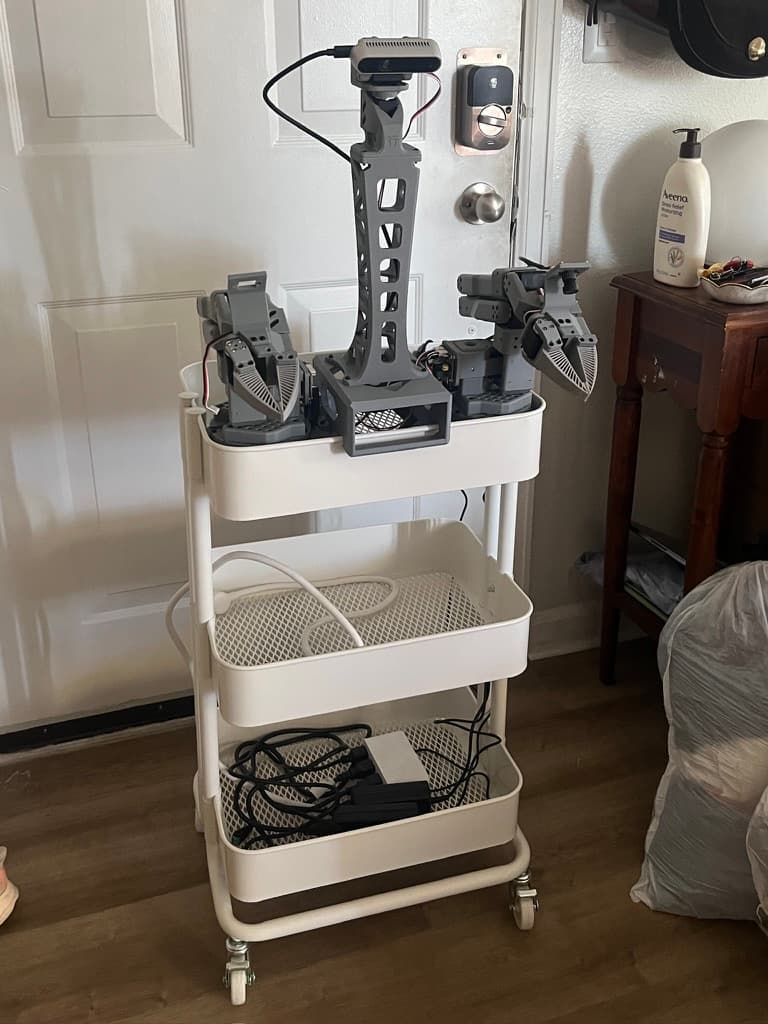
xLeRobot Platform
2026 - PresentVision-to-grasping pipeline for low-cost robotic hardware
A perception-to-manipulation system built on xLeRobot hardware with RGB-D sensing, camera-to-base transforms, and task-based inverse kinematics.
ranegray/pincer →
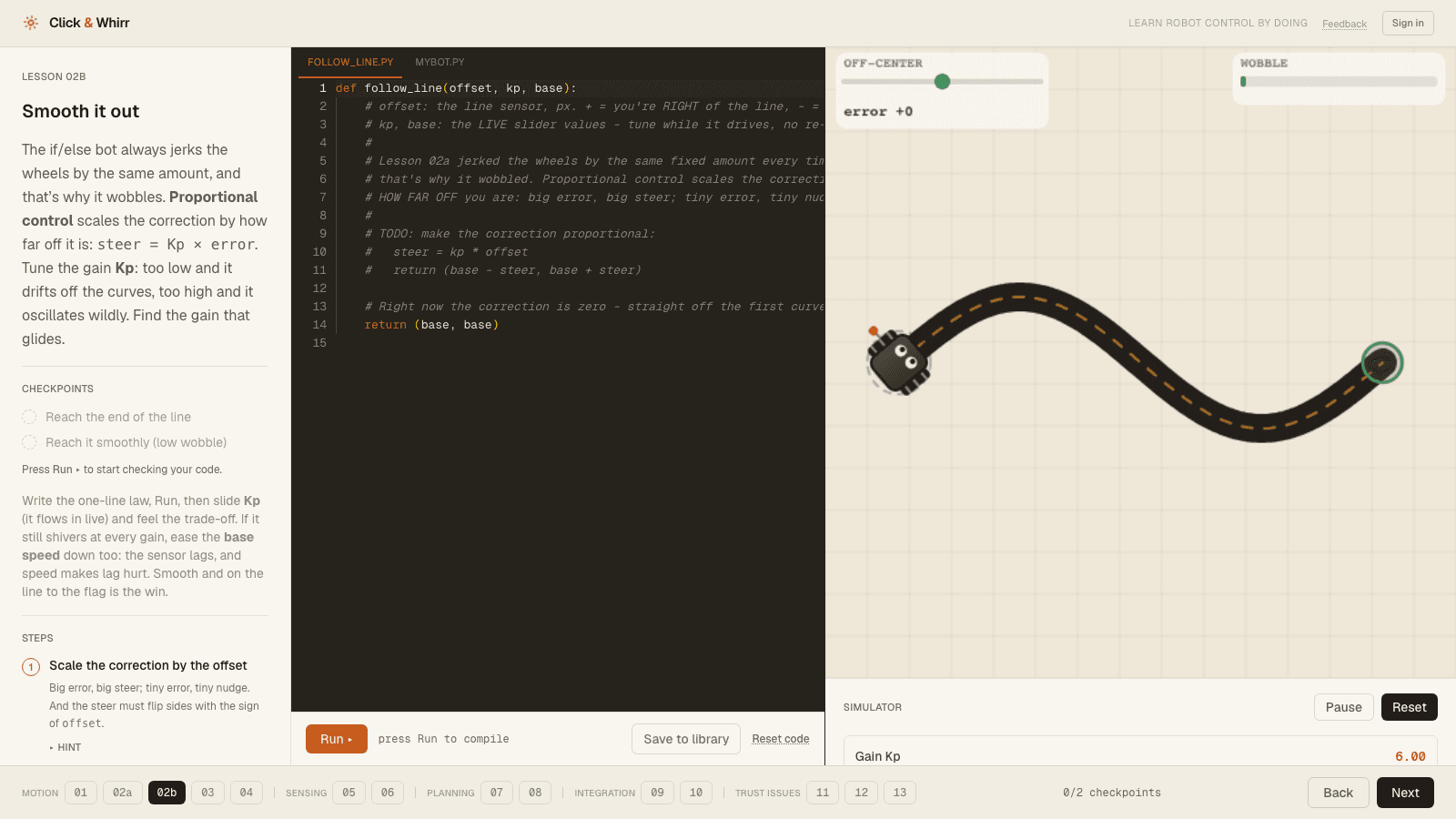
Click & Whirr
2025 - PresentInteractive lessons for learning robot control in the browser
A learning platform where students write real Python to drive a simulated robot, covering line following, PID control, odometry, and path planning, building up their own robot library lesson by lesson.
clickandwhirr.com →
Before robotics
Ten years as an F-16 avionics systems expert in the Air Force and Colorado Air National Guard, across Arizona, South Korea, Germany, and Colorado. I led a 23-person team keeping mission-critical electronics working on aircraft that could not fail. That is most of why I care about the boundary between what a system can be trusted to recover from and what it must never be allowed to try.